
Berlin can be daunting in terms of its cultural offering. The extensive musical community operating within its borders leaves room for a large number of niches across many musical genres to emerge and thrive. While most electronic music lovers might be familiar with the city’s reputation as the European techno and club music capital, a vibrant scene of noise, free improvisation and other forms of contemporary music is also an enduring part of the city’s ecosystem. Dubbed Echzeitmusik in the late ‘90s by a group of musicians affiliated with three main venues 2 of which are now defunct, the Berliner experimental scene encompasses everything from sound art to power electronics. If other cities like London and Paris have legendary venues Café Oto and Instants Chavirés respectively which have been nurturing and disseminating to this particular style of music for close to 30 years, in Berlin, things have been more volatile.
While venues like Ausland are still regarded as pillars of the Echtzeitmusik community, the closest equivalent to London and Paris experimental music institutions would be KM28. A small concert space located in the south east district Neukölln, an area known for its hip bars, record stores and predominantly Turkish and Arabic population. KM28 describes itself as “a volunteer-organized venue for contemporary concert music founded in late 2018 and located at Karl-Marx-Str. 28, 12043 Berlin. ”
After a friend’s recommendation, I ended up seeing Shelley Hirsch play on a cold December night in 2019. I have since kept up with its programming on my frequent Berlin visits and since moving here mid-November, it has become one of my favorite local hang outs. In the past six month i’ve seen Matmos and Jennifer Walshe do an improvised show together, a vocal rendition of Éliane Radigue’s “OCCAM XXII” by Yannick Guédon and the miniature festival showcasing new improvisational configurations between members of Xiu Xiu and artists such as Susie Ibarra, ota:yonii, Tom Nguyen and Victoria Shen organized by Audrey Chen.


It is the kind of place where you quickly get to recognize the people working there and regulars after a couple of visits, with an overall convivial atmosphere. I first came across Marta Forsberg’s work through her tape New Love Music on Warm Winters Ltd and was instantly taken by her delicate melodic drone collages but I hadn’t had a chance to see her perform. I certainly didn’t expect to walk into a packed room on Friday evening considering we are in peak culture season. There were at least 40 people, which was almost double the audience members I could guesstimate two weeks prior for a Horse Lords saxophone player Andrew Bernstein’s solo show. A few minutes before the start I managed to secure a seat further back near a friendly older gentleman (who later turned out to be famous circuit bending author Nic Collins). I normally prefer to be as close as possible to being fully immersed in the music experience. I was not familiar with the first duo, both Alanas Gurinas and Sholto Dobie being sound artists from Lithuania. Their set started very quietly with a series of silently humming DIY critters scattered across the room. I managed to get a peek at the ones placed on the bar as they walked and activated various miniature installations.
The performance, lasting less than 25 minutes, was a highly effective set. Considering how quietly they were playing and the venue’s tendency to get quite a bit of noise pollution from the busy boulevard, the audience was positively entranced. Well not being able to fully see the devices, the most obvious sound making unit Gurnas was using were these suspended water jugs to which he attached some sort of tiny electronic that made them vibrate. Talking to him after the show, he told me that attaching the funnel to the water filled jugs made the proper sound amplification, turning the object into a speaker, while the little electronics were just motors set to a timer. He was also adjusting the water levels in order to modulate the sound throughout the performance. Dobie on the other hand was playing a sort of arta povera futuristic bagpipe. Basically, it was a collection of plastic tubes scotch-taped together, with additional funnels. The whole set up reminded me of Tetsuya Umeda’s work in terms of using Lo-Fi sonic objects triggered and adjusted throughout the performance. The public’s applause was ravenous.


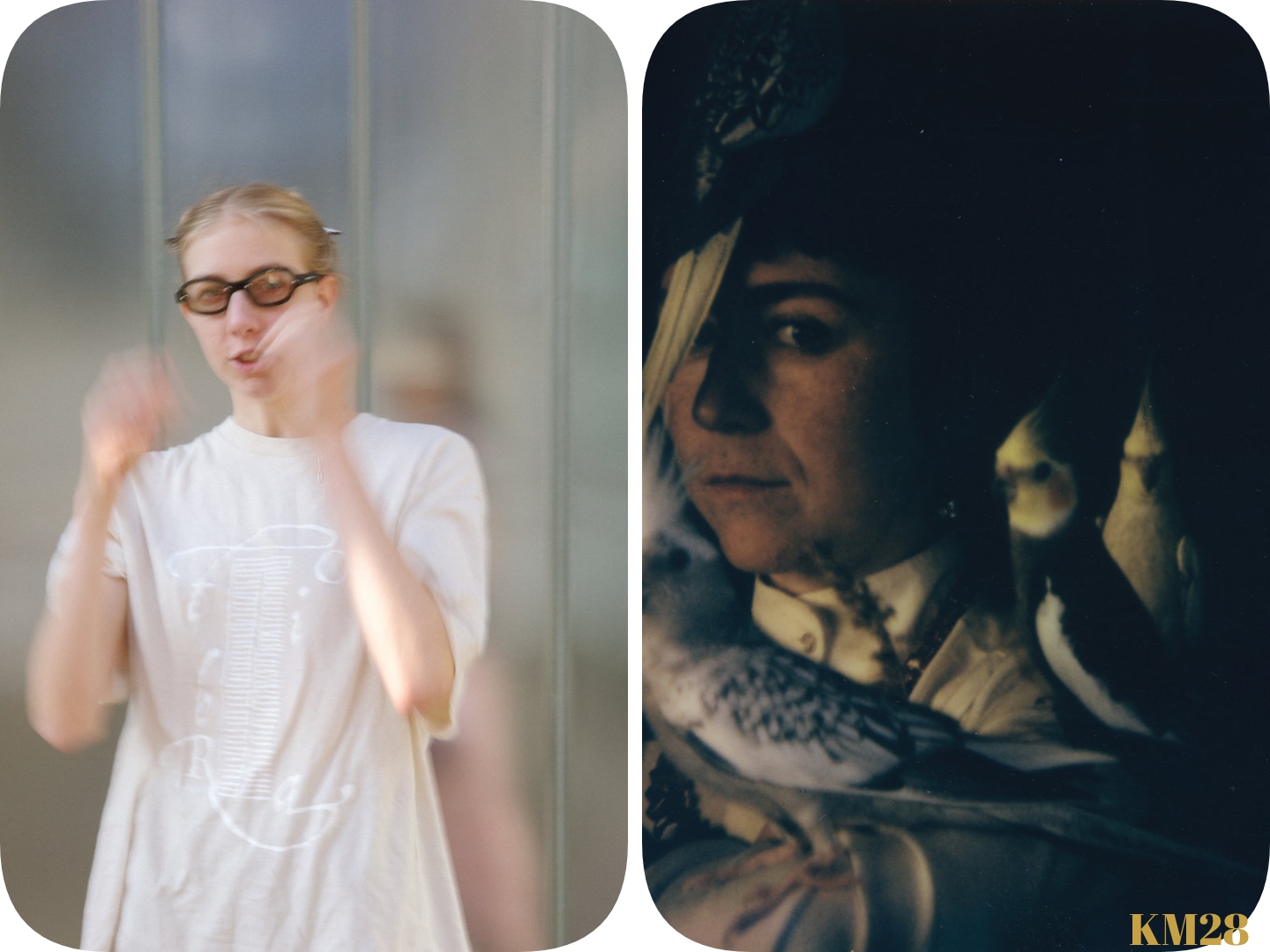
Marta Forsberg and Mara’s set followed after a quick break. They started with a series of field recordings, featuring overheard conversations, squishy sneakers on basketball courts and bits of pop music playing in the distance. I remember a guest lecture at my old university Paris 8 where INA-GRM director François Bonnet first talked about the validity of music playing from various sources in an environment as field recordings. Theur set unfolded slowly, the two lingering on each idea, punctuated by electronic flutters from Forsberg’s synthesizer and Marta’s Ableton sounds. When they finally picked up their respective instruments of viola (Mara) and violin (Forsberg) halfway through, it felt almost cathartic. Talking to Forsberg a few days after the show, I learned that this has been a first time encounter for the two improvisers and that Mara came up with the structure. They first met up for an interview on Mara‘s radio show and Mara suggested they play field recordings to each other as the core building block of a score for the performance that would last around 45 minutes. While I did appreciate the meeting of ideas and reciprocity of their dialogue, it felt a little more self-indulgent than the previous set, while moving nonetheless. Personally, I would have done away with the 20-minute field recording part but my attention span is fried. Overall it was a very satisfying night, the kind where one’s expectations are being subverted in the best way possible.
