

This week’s guide is by CF Smith and contributors Arifur Rahman, Benny Thomas, Imran Mirza, Gavin Senaratne and Irfan Ayaan.
Some of the best music has a way of slipping through the gaps. If you follow us regularly, you know there’s a whole world of releases quietly reshaping sound, waiting for curious ears to stumble upon them. That’s where Between The Cracks comes in. This week, Indian classical, new age jazz fusion, experimental jazz improvisations, world fusion, and more… Read the mini-reviews, listen to the music and, most importantly, hit the buy/share link. Happy listening, and have a lovely weekend
Albums
Clear Path Ensemble – Black Sand
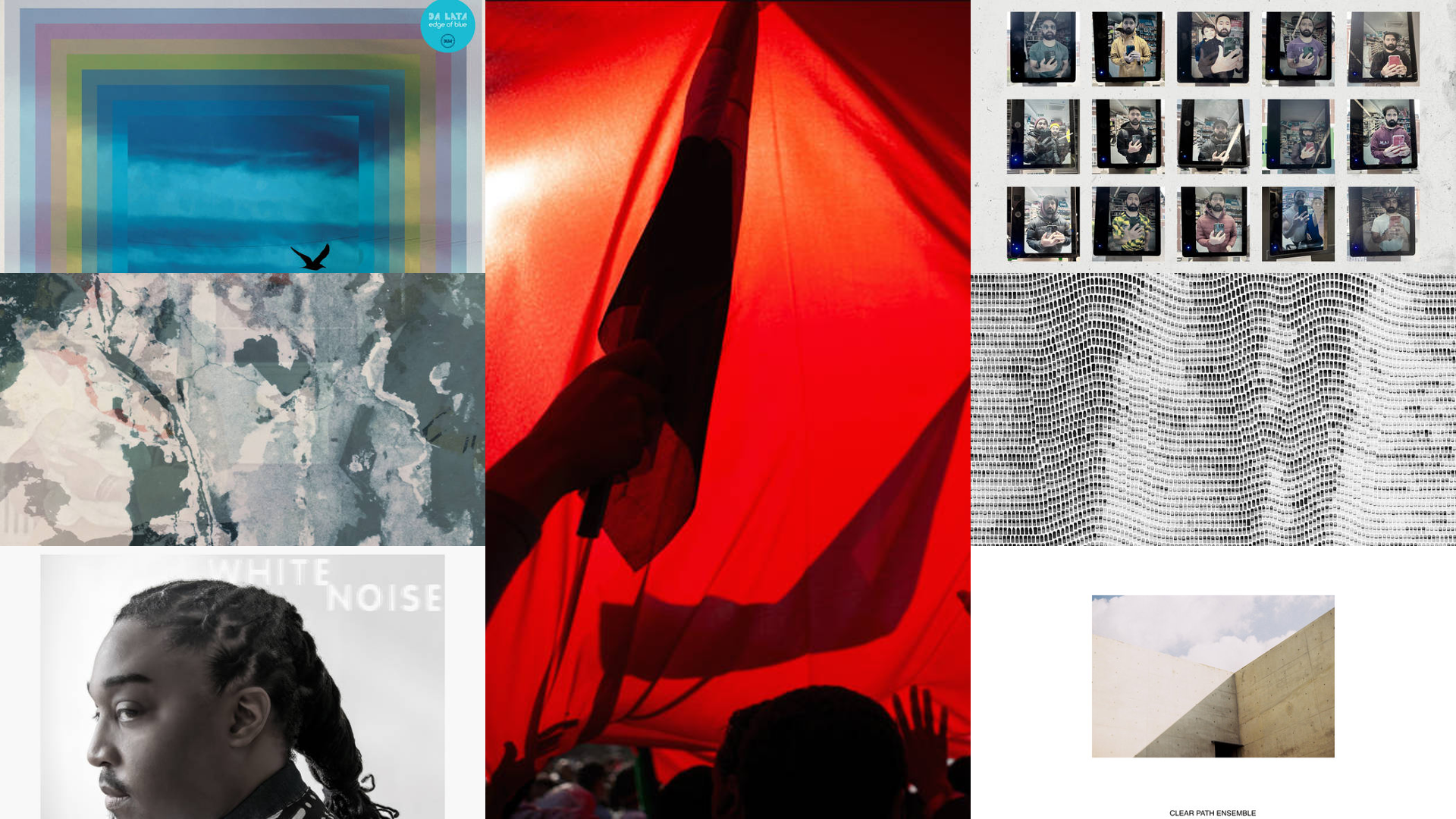
It’s been 3 years since the last Clear Path Ensemble album, and the latest, Black Sand, is a work of beauty. Clear Path Ensemble’s third album, Black Sand, sees the New Zealand jazz collective embrace a more introspective, refined sound. Led by multi-instrumentalist Cory Champion, the nine-track journey marks a departure from their previous high-energy excursions into funk and electronica, opting instead for a carefully measured approach inspired by Japan’s deep listening ambient and jazz record bars. The album opens with the delicate ‘From Winds’ before gradually building atmosphere through pieces like ‘Brain Tickle’, where Champion’s vibraphone work takes centre stage. The ensemble masterfully blends West Coast cool jazz with Latin and Afro-Cuban influences—particularly evident on the vibrant ‘Calypso’ and ‘Best Life’ where flute and percussion create an uplifting shuffle. ‘Cascade d’Arts’ strips things back to minimalist percussion and vibes, showcasing the group’s confidence in restraint. This is jazz-new-age fusion at its most elegant—a lovely companion for downtime that rewards close listening without demanding it. – CFS
Emergence Collective – Swimming in the early hours
It’s challenging for an acoustic improvisatory ensemble to gain visibility, so I am always happy to help spread the word. Sheffield’s sonic roamers, Emergence Collective, entered the studio weaponless, no plans, just a chosen key, and let four sprawling soundscapes unravel across 52 minutes. Classical whispers tangle with jazz exhalations and folk murmurs, all drifting through reverberant dimensions where restraint becomes its own rhythm. One day. One take. The hypnotic geometry that emerges feels impossibly deliberate for music born in the womb of improvisation. The two standout tracks bookend this album, with the other two in between providing a savoury filling. Like watching clouds form intelligible shapes, or finding patterns in ceiling cracks at 4am—Swimming operates in that liminal frequency where coherence and chaos slow-dance, breathless, tender, gloriously unmoored. – BT
Sarathy Korwar – There Is Beauty, There Already
There Is Beauty, There Already marks Sarathy Korwar’s most introspective offering yet—a hypnotic 40-minute drum suite celebrating percussion’s melodic power. Recorded over four days at Real World Studios with collaborators Photay, Magnus Mehta, and Joost Hendrickx, the album flows as transcendent improvisation, blending tabla, ghatam, marimba, and Buchla Easel textures. While the instruments might have been exotic, choosing the right people took precedence over finding the right sounds. Korwar explains, “I’ve always believed that if the people are inspiring, then they will bring the right sounds with them! I chose people who live between electric and acoustic worlds. The musicians were all comfortable improvising, letting go and building a new sonic world together.” Drawing from Indian folk music, Max Roach’s M’Boom, and Terry Riley’s minimalism, Korwar’s seventh release eschews weighty themes for raw vulnerability. The repetitive, circular structures induce trance-like states, exploring rhythm as a transformative force. His newly launched Otherland label houses this deeply personal work—proof that sometimes returning to fundamentals reveals deep beauty. – BT
George Burton – White Noise
The notion of rebellion and general protest in music seems to have reached new heights in the last five or so years. Donald Trump’s ascension to Presidency in the US sparked an incredible response from music communities as a divided America sought to comprehend its new place within the global landscape; the events following Harvey Weinstein’s downfall sparked an explosive and fiery debate about women’s place in society with countless impassioned voices coming through; the death of George Floyd at the hands of arresting police officers, again, held a mirror up to America forcing it to address some serious questions about the very nature of its own soul. In 1971, Marvin Gaye asked the question ‘What’s Going On?’ in the way that other soul luminaries, including Gil Scott-Heron and Curtis Mayfield, had in their respective ways. Maybe that’s a question we, as a society, are forever destined to ask about the governments and politics that influence and dictate our everyday lives, and in 2025, George Burton stands atop the soapbox to ask that very same question. The release of Burton’s fourth full-length album in ‘White Noise’ stands as a bold statement of intent for the pianist, composer and bandleader. As a highly decorated and highly educated artist, Burton’s music has always sought to present an honest depiction of himself as much as of how he perceives the world around him. From his Derrick Hodge-produced debut ‘The Truth Of What I Am > The Narcissist’ (2016), Burton’s honesty is laid out through a sensational release. Establishing himself almost immediately as a boundlessly creative and imaginative artist, Burton’s perspectives on his music respectfully hark back to jazz’s architects while still envisioning a genre whose story is still very much unwritten – through his debut and his subsequent follow-up in ‘Rec·i·proc·i·ty’ (2020), Burton’s distinct perceptions of jazz owe as much to neo-classical stylings as they do to hip-hop. ‘White Noise’ is an incredible project. An album that is both a reckoning and a release, and while it carries on the lineage of music that bravely asks ‘what’s going on?’, Burton understands that part of that answer comes from deep introspection as much as through the words and actions of others. – IM
Neti-Neti – Echo of Being: Grace in Rot
Forged in the crucible of loss, music duo Neti-Neti, comprising vocalist Amirtha Kidambi and percussionist Matt Evans, deliver a haunting record with Echo of Being/Grace in Rot. Released on October 10, 2025, this album channels the raw ache of grief into a meditative exploration of existence, decay, and renewal. The titular tracks are strong representations of the album’s thematic spectrum. ‘Echo of Being’ is a silent single, focused on vocal effects and percussion to create an eerie, almost otherworldly soundscape. It’s more about atmosphere than expression, and sets the tone for the rest of the record. Meanwhile, ‘Grace in Rot’ is an impactful track that uses powerful percussion and chants to make a lasting impact. The use of delay and distortion is tasteful throughout the album, but it stands out on this track, elevating the screams and harmonies Kidambi delivers. Echo of Being/Grace in Rot is a bold, introspective gem; an almost ritualistic soundtrack for processing loss. Whether it’s expressed through restraint or an outburst, every track lands with incredible emotional intensity. Neti-Neti’s latest endeavour is an experience that’s not to be missed. – GS
Da Lata – Edge of Blue
Okay, so Edge of Blue is an absolute vibe. After 25 years since their debut, Da Lata’s Chris Franck and Patrick Forge are still serving up that North London Tropicalia magic, and honestly? They’ve never sounded this good. This album is like sunshine in your speakers—blending Afro-Brazilian grooves with downtempo soul in a way that works. Laced with some incredibly talented voices, including the likes of Sukirti Uikey, Bembe Segue, Lenna Bahule, and the group’s own Chris Franck, who sings on a Da Lata track for the first time on the standout ‘The Lonely City’. The third track, ‘Tsinguipa’, featuring Bahule, wholly epitomises the blend of Afro-Brazilian beats with melodies from North London. The resulting harmonic cacophony creates a jovial, light, and swaying atmosphere, perfect for setting the mood at any cultural festival or gathering. The song begins with the bouncy rhythm of samba drums, accompanied by lively vocals and traditional music sounds. The song picks up the beat, and several other instruments join in to set the album’s intended mood. The track is followed by ‘Caberá’, which opens with soft guitar strumming, a markedly different sound from the upbeat of the previous track. The album continues smoothly, transitioning from upbeat rhythms to calm melodies, further emphasising how beautifully traditional and cultural elements can be blended into modern or urban music. Perfect for late-night listening or lazy Sunday afternoons. Da Lata has crafted their most accomplished work yet. – AR
MidnightRoba – Raise A Symphony
MidnightRoba’s ‘Raise A Symphony’ hits different – and it’s exactly what we need right now. The second solo album from the voice of Attica Blues is a powerful 15-track journey that clocks in at just over an hour. And honestly? It doesn’t waste a single minute. If you follow MidnightRoba (aka Roba El-Essawy) across social media, then it will come as no surprise that Raise A Symphony balances heavy topics with genuine soul. Across the album, she tackles everything from colonialism and corrupt politicians to displacement and migration, and she does so with an incredible mix of anger, hope, and warmth. The title itself comes from MLK’s “I Have A Dream” speech, and you can feel that spirit of unity woven throughout. The production is all hers, with self-produced electronic vibes that create an atmospheric, contemplative space. But she’s smart about bringing in collaborators where it matters. Saul Williams shows up on “Axis” to deliver his signature spoken-word intensity, while Deschanel Gordon features on the opening ‘Joy (Reprise)’ and closing ‘Faith’, creating this beautiful bookend effect. Tony Kofi’s contribution to ‘After Home’ needs to be heard! Standout moments? ‘Listen’ literally embodies the album’s purpose – calling righteous people to come together and raise that symphony. ‘The Honourable’ asks uncomfortable questions about integrity and compromise that feel painfully relevant. And ‘Sea Song’ is hauntingly beautiful, weaving personal memory with the refugee crisis. The whole thing flows like a meditation, sometimes sombre, sometimes uplifting, always purposeful. It’s one of those albums where you need to sit with the lyrics to fully appreciate the impact. Not background music, you know? – IA
