

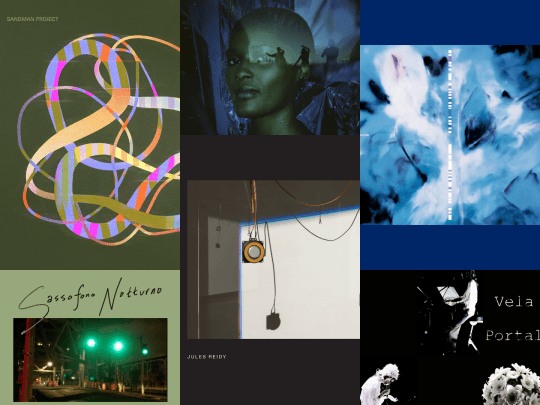
This week’s guide is by CF Smith and contributors: Words By Shoaib, Benny Thomas, and Irfan Ayaan.
Every week at Twistedsoul, we wrap things up by sharing new releases that caught our ears, brilliant, wide‑ranging picks we believe shouldn’t slip past anyone. Today’s selection includes albums by Sandman Project, Vela, Asa Tone Jules Reidy, alongside a couple of other brilliant finds. We hope you’ll find some music you love and feel excited to hit the buy button. Happy listening and have a lovely weekend.
Albums
Sandman Project – Hearts Forever
Hearts Forever is the first Sandman Project album entirely composed, arranged, and produced by guitarist, composer, and bandleader Tal Sandman, written after her move from Jaffa to Leipzig, and it feels more intimate and self-assured than the band’s debut. Arriving in Germany without knowing whether she would find the right collaborators, she gradually assembled a new band through recommendations from fellow musicians, discovering a group capable of bringing her musical vision to life. Katara opens with a hypnotic groove led by classical oud and Middle Eastern rhythm, built from a melody that arrived in Sandman’s mind. Questions Answers shifts the momentum up a gear, driven by Afrobeat-inspired drumming and a call-and-response between desert-rock guitar lines and punchy brass, with layered vocals and a loose surf-punk finale. So Said The Stone carries some of Jaffa’s restless energy through 70s funk, Afrobeat, and Middle Eastern guitar lines. The title track Hearts Forever sits at the centre of the record, more direct and soulful than much of the band’s earlier material, bittersweet and hopeful without being naive. Abandawe folds Moroccan guimbri-inspired guitar, Ethiopian melodic ideas, and funky brass into one of the album’s most intricate arrangements, while Kishuf slows the pace toward a desert Woodstock, with Sandman’s magic flute transformed through reverb and delay. Closer, Feelings Of Hope answers the anger and division Sandman sees around her with the whole band singing together as a choir before a searching one-take guitar solo. The album is almost entirely instrumental by design, and the few vocals work as texture and choir rather than storytelling, so the music is never confined to one language or one listener’s story. – IA
Vela – Portal
Ichiko Hashimoto and Miyako Koda both have a penchant for light, immersive, minimalist soundscapes. The two forces of the Japanese avant-garde and ambient scenes connect in a 5-track project where Hashimoto’s deeply undulating acoustic piano and layered textures meet Koda’s distinctively airy, crystalline tones and whispered spoken-word passages. The opening is a sparse ‘prologue’; Koda’s voice doesn’t really sing—it weaves through the air in soft, breathy textures that float in the background like wisps of smoke. It’s difficult not to feel the hairs on the back of your neck stand on end when Koda’s voice appears on ‘MIYAKO‘. Seriously, against Hashimoto’s warm melodic piano chords, Koda’s voice sounds better than ever. The gorgeous, ‘primavera‘ subtly changes the mood, pairing brighter ambient hues with expansive vocal arrangements that evoke renewal and fragile beauty. The title track shifts again, with the duo crafting an uptempo, deeply atmospheric, tension-filled piece as Koda delivers a striking yet airy spoken-word poetic reading. The journey is rounded out by haunting sounds of ‘and ever‘. A throbbing ambient pulse sets the scene as gorgeous piano keystrokes cradle the captivating vocals, both gradually rising in intensity as the piece unfolds. Don’t be surprised if this track, well, the whole EP, ends up on constant repeat (it did with me). Beyond a doubt, this is a beautifully crafted and astonishingly emotive work of avant-garde ambient bliss. Music doesn’t get much better than this. – CFS
Asa Tone – Mutualkind
First encounter with Asa Tone and I’m smitten. After a quick search on Twistedsoul, I see they’ve been covered plenty of times, so I’ll be checking out what else they have been up to. Based across Indonesia, Mexico City, Berlin, and New York, Mutualkind is the sound of three minds, Melati ESP, Tristan Arp, and Kaazi, building a musical language from warped vocals, modular squelch, electronic percussion, and happy accidents. Melati’s voice keeps shape-shifting into rhythm, while Balinese kendang from Putu Septa slips into two tracks (‘Jalur-Jalur‘ and ‘Ember‘), joining the conversation beautifully. Some of it was played live in single takes (‘Second Language‘ and ‘Water Talk‘), and some was stitched together from afar, but it all feels wonderfully in sync, playful, intricate electronic music where nothing stays in its lane for long. Only two albums in, Asa Tone sounds remarkably self-assured, carving out a uniquely theirs musical space. – BT
Jules Reidy – Clerestory
Released a few months ago and despite only listening to it once, this is a strong contender for avant-garde classical album of the year. If last year’s brilliant Ghost/Spirit was about stretching into poppier territory, Clerestory feels more like a return to the deep, acoustic microtonal textures that defined works like 2023’s Trances. Jules Reidy’s new album Clerestory is a deeply immersive exploration of reflection and resonance. Split into two interconnected works, the album brilliantly blurs the boundaries between acoustic precision and electronic distortion. Side A, Shadow Symmetric, the near 18-minute-long piece features the renowned JACK Quartet performing a meticulously tuned string chorale. By layering two closely related tuning systems, Reidy generates uncanny near-unisons, delicate beating tones, and subtle dissonances that ground the piece in a quiet, haunting melodic thread. Side B, Clerestory Windows, sees Reidy breaking that foundation apart. Reimagining the quartet’s material through a kaleidoscope of voices, guitars, synths, and heavily stretched textures, partly inspired by their 2025 installation Inside, Crystals and Circuitry, Reidy shifts effortlessly from fragile minimalism to vibrant walls of sound. – CFS
megiapa – Intentions
Before Intentions, megiapa mostly worked in private, sketching playful loops for Chicago’s underground beat circuit under the pressure of single-evening deadlines. This debut full-length radically slows down that clock. Chronicling five tumultuous years marked by pandemic displacement, the painful collapse of a partnership, and an eventual move to Los Angeles, the record functions as a living archive of personal renewal, turning raw uncertainty into deep-pocketed spiritual soul. That emotional vulnerability cuts sharpest when megiapa confronts romantic wreckage directly. On opener ‘Open Your Eyes’, producer 10.4 ROG lays down sparkling electric keys and insistent chimes, creating an airy front porch for her reflections on communal grace. The mood bruises on ‘Can’t Believe’, where Resavoir’s Will Miller threads mournful trumpet and Electronic Valve Instrument lines across skeletal Roland 808 kicks. Longing hangs heavy in the room. Instead of masking her ache with studio polish, she lets her voice crack with plainspoken dignity. Yet grief never traps this music indoors. Reaching into Chicago’s rich Afrofuturist lineage, megiapa reimagines Charles Stepney’s psychedelic classic ‘Black Gold of the Sun’, letting Aisha Mars‘s fluttering flute and Mic Holden‘s percussion lift the arrangement into warm sunlight. That cosmic impulse blooms across two companion pieces directly inspired by Sun Ra. While ‘( ( on the spaceway ) )’ frames Sun Ra’s spoken archival wisdom over Ahmad Muhammad’s gentle piano chords, sister track ‘on the spaceway (frfr)’ launches into zero-gravity with Telemakus, layering Rhodes, acoustic harp, and fluttering synths to envision Black joy as boundless expanse. Handmade, patient, and quietly radiant, Intentions proves that true creative healing begins the moment you stop fighting the unknown. – WBS
Sassafono Nocturno – I Pianeti
Sassofono Notturno is a collaboration between Stuart Bogie, Dave Harrington, and Philip Weinrobe, where acoustic breath meets analog warmth. Stuart Bogie’s woodwind is sensitive and atmospheric; his phrases bloom and recede like comets, while Dave Harrington’s synths and electronic percussion map a wide, cosmic field. Philip Weinrobe’s live sound manipulation threads the two, absorbing it all and turning moments into moving textures rather than fixed songs. The result is experimental ambient jazz that’s both spacious and intimate; head straight to ‘Marte‘, ‘Saturno‘ or ‘Nettuno‘ and let the music pull you into its slow‑burn gravity. It’s music for early mornings, slow afternoons, and late nights; you choose the moment, relax, and let it settle in. Nine pieces of quietly adventurous, patiently unfolding music that’s already rewarding on first pass. – CFS
