
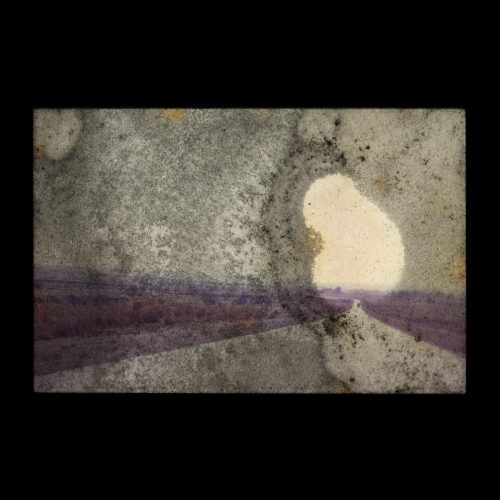

Inspired by Stellenbosch University’s Hidden Years Music Archive, South African musician and researcher Cara Stacey presents a fragile, haunting and deeply thoughtful record with ‘Hypha’. The silence, damaged images, and deteriorated tape of the archive are folded into piano, strings, guitar and flute until memory itself feels unstable.
Over the album’s 10 tracks, Stacey is supported by the pointillist interventions of guitarist Keenan Ahrends and violinist Matthijs van Dijk.
The opening track, ‘Grain and Dot’, exemplifies the album’s artistic approach, as it seems to grow from small scratches, drones, and resonances rather than from fixed song forms. Built from hydrophone recordings of fish and a tangled web of composed melodies for guitar, piano, and violin, the piece drifts between the organic and the orchestrated, blurring the line between the two worlds.
Named after the branching, thread-like structures of a fungus. The title track blends fluid bow melodies and garbled voices with sharp, responsive interventions from the violin and guitar.
Moving to ‘Code’, which lands closest to the vibe of Stacey’s 2015 release Things That Grow, with a gorgeously woven yet experimental interplay between piano chords and bowed vibrations. It digs into archival cataloguing and hidden communications, treating the archive’s text and numbers as a kind of coded score for musical interpretation.
‘Seams I’ takes on a bolder sound while ‘Seams II’ shifts into a more retro aesthetic. These pieces explore decay in border zones and transitional spaces. The live performers take on a more pronounced role, while the background audio is stitched together from the quiet scraps of archives – silent listening, in‑between breaths, crackles, and the tense moments before recording begins.
Written by Stacey over a ten-year travel period. The labour of love is deeply felt in her voice on the melancholic, deeply atmospheric ’End Song’, which quietly steals the whole record for me. Towards the end, Stacey takes an archive titled ‘Dickman Reberio 1970’, in which John Dickman sings a Bob Dylan piece. The original tape is stretched, warping Dickman’s voice into a grainy mesh of buzzing frequencies as it unravels. It’s pure genius and turns a straightforward folk number into something more twisted.
‘Syntrophy I‘ and ‘Syntrophy II & III’ close out the album, experimenting with dramatic variations in tone and dynamics along the way.
At its best, Hypha feels like a mycelial network of sound: quiet, strange, organic and interconnected, but what makes the album compelling is its tenderness.
It is not an immediately accessible record, and listeners looking for melody-led jazz or folk may find it too abstract. But as an act of archival imagination, Hypha is beautiful and quietly radical.
