

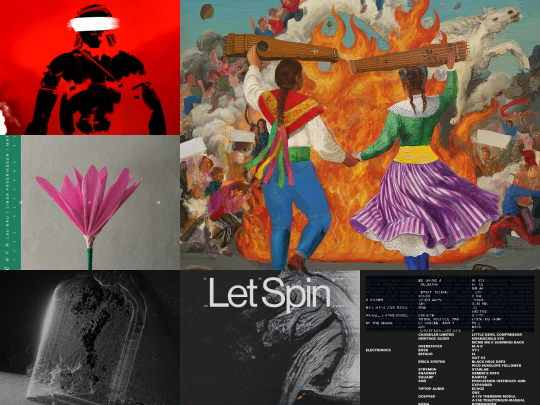
This week’s guide is by CF Smith and contributors Words By Shoaib, Benny Thomas, and Irfan Ayaan.
To wrap up the week, we bring you a new edition of Between The Cracks. Six gems from anywhere and everywhere, you know, releases that slip through the cracks, but deserve louder applause, and reward anyone willing to dig a little deeper. Let Spin, Visible Cloaks, Kiri Ra!, and 9ms sit among the artists colouring today’s roundup, along with a few other treasures. We pair every pick with a mini review – read, listen, explore, and support.
Albums
Visible Cloaks – Paradessence
Paradessence is Visible Cloaks’ first full-length since Reassemblage, and it deepens their interest in the border between natural and artificial sound. The duo treat acoustic playing and virtual synthesis as parts of the same ecosystem. Apsis introduces the palette with flickering tones that seem to appear and vanish on their own. Balloon builds on that with a more playful, buoyant motion. Melodies float upward and then slip out of focus. Capgras hints at unease and doubled realities, which fit an album that constantly asks what is real and what is simulated. Across fourteen tracks, the details matter. Fragments of voice, room noise, and digital artefacts are blended so tightly that edges disappear. The music feels generative even when it is carefully composed. Paradessence often plays like wandering through a lush garden and slowly realising much of it might be a projection. It is precise, softly dazzling, and very easy to live inside for a long time. – IA
Odd Okoddo & Ogoya Nengo – Palagoma
At 83, Ogoya Nengo remains a magnetic presence, but Palagoma is far more than a legacy project. This collaboration with Odd Okoddo, the duo of Olith Ratego and Sven Kacirek, feels like a meeting of generations, traditions, and musical languages that somehow arrive at the same destination. The album’s blend of Kenyan folk forms, minimalist electronics, and hypnotic percussion never sounds forced. Instead, it moves with the patience and confidence of artists who trust the power of space as much as sound. The title track, ‘Palagoma’, drifts on dreamlike electronics and subtle rhythmic pulses while Nengo’s voice carries a quiet authority that instantly grounds the music. ‘Bara’ leans further into the trio’s electroacoustic vision, pairing intricate percussion with atmospheric textures that blur the line between ritual and experimentation. Across the album, themes of love, pain, and resilience emerge naturally from the interplay between ancient vocal traditions and contemporary production. Palagoma is a strikingly original work: intimate, adventurous, and deeply human, proving that innovation often begins with listening closely to the past. – WBS
Kiri Ra! – nen
After a five-year hiatus, Kiri Ra! returns with nen, a stunning album that showcases their exceptional talents. Most ambient records are content to disappear; nen lingers like weather trapped indoors. On their latest, Kiri Ra! – Lau Nau, Linda Fredriksson, and Matti Bye, turn improvisation into something tactile and uncanny, where piano, reeds, modular synths, and percussion seem less arranged than slowly uncovered. Ten years in the making, the band describes it as music that “doesn’t try to be anything”. The trio’s gift is restraint with pressure behind it: every phrase hovers, every silence feels shaped, every small sound carries unexpected emotional weight. The record also benefits from the fact that these musicians come to spaciousness from different directions. Fredriksson’s presence keeps the music from floating clean off the floor. Lau Nau brings a kind of devotional strangeness, the feeling that electronics and folk memory are not opposites but cousins. Bye, meanwhile, gives the trio a quiet architectural logic: not rhythm, exactly, but placement, proportion, the sense that each sound has been allowed to find the exact right corner of the room. What keeps the album from dissolving into tasteful haze is its physicality; you hear wood, warmth, love, metal, and electricity rubbing against one another in real time. It’s just their second album, and you might’ve missed them so far, but trust me, once you hear this, you’ll be a fan. Begin with the stunning title track and let the rest unfold from there – a true beauty. – BT
9ms – Lunch
On Lunch, Munich duo 9ms loosen the screws on their machine-driven experiments without losing any of the precision that made their earlier records so compelling. The album feels more playful, more spontaneous, and noticeably warmer, even while it dives deeper into dubby IDM textures, broken drum patterns, and strange little rhythmic detours. You can hear the freedom in these tracks. Created during short morning sessions squeezed in before family obligations, Lunch carries the energy of artists working without pressure, simply following curiosity wherever it leads. Driven by a specialised drum resonator that blurs the boundary between rhythm and melody, M€mo employs a cinematic soundscape. ‘Court’ is one of the album’s strongest early highlights. Thick, compressed drums punch through hazy synth textures while the groove constantly shifts underneath itself. There’s a tension between movement and restraint that makes the track addictive. It feels mechanical but never cold, with small details appearing and disappearing like flickers in peripheral vision. The dub influence gives it space to breathe, while the stereo effects make the whole thing feel larger than its runtime. ‘Heiopei’ leans further into the duo’s playful side. The percussion stumbles and pivots in unexpected ways, but the track never loses momentum. Beneath the fractured rhythms is something oddly hypnotic, almost meditative. Elsewhere, on Udon, the duo thickens the bass frequency while scattering spatial, echo-drenched percussive hits. On Swim, they create a fluid, organic motion: a wash of shifting synths set against a steady, clock‑like rhythm and unstable textures. 9ms balance precision with looseness beautifully here, allowing the machines to feel human rather than rigid. Across Lunch, 9ms continue carving out a space entirely their own. The album thrives on contrast: dense but airy, cerebral but physical, experimental yet approachable. It’s the sound of two artists trusting instinct over concept, and the result is easily their most engaging record yet. – WBS
Cocanha – Flame Folclòre
With Flame Folclòre, Cocanha deepen their commitment to Occitan culture not as preservation, but as resistance, celebration, and reinvention. For Lila Fraysse and Caroline Dufau, singing in Occitan is inseparable from identity and politics. Their music carries the weight of an endangered language while refusing to trap it inside museum-piece folklore. Instead, they treat Occitan tradition as something living, communal, and constantly evolving. That spirit runs through the entire album. The hypnotic hand percussion, tambourines, and interwoven polyphonic vocals feel ancient and immediate at once, grounded in dance, ritual, and collective memory. Cocanha’s passion for Occitan storytelling and oral tradition gives the record a deeper emotional gravity, especially when repetition becomes almost trance-like. The album opens with Remenanuèch, which moves with a restless drive, its title reaching back to the drac of Occitan mythology, a creature known for its shifting forms and trickster energy. ‘Clam’ is one of the album’s strongest moments. The repetitive pulse builds slowly beneath the duo’s layered voices, creating tension through rhythm rather than volume. It feels ritualistic without becoming theatrical, balancing intimacy with collective force. The track’s hypnotic momentum captures exactly what makes Cocanha so compelling. Experimental piece Diurê Tremblar, the second in a three‑part Rondeau sequence, becomes a sonic collage: a clipped news report on the killing of UnitedHealthcare CEO Brian Thompson flickers in, the dial shifts, and suddenly the familiar voices of Dufau and Fraysse drift through as if caught on late‑night radio. The title track, ‘Flame Folclòre’, pushes the album’s themes even further. The percussion lands heavily while the vocals circle each other with sharp intensity, turning folklore into something defiant and contemporary rather than archival. What makes the Flame Folclòre resonate is how fearlessly Cocanha reshape tradition. They honour Occitan heritage while rejecting rigid nostalgia, allowing old melodies and contemporary struggles to coexist naturally. Flame Folclòre does not simply revive folk music; it insists that culture survives through movement, change, and collective voice. – WBS
Let Spin – I am Alien
Let Spin is the London/Berlin-based post-jazz quartet, featuring Chris Williams (sax), Moss Freed (guitar), Finlay Panter (drums) and Ruth Goller (bass). They return with their fifth and possibly strongest album, ‘I am Alien’, which feels like a natural follow-up to their last and does not disappoint. Trying to pin the album to a single genre feels reductive. The band moves with too much intent, too much range. Their collision of jazz impulses and progressive rock architecture lands with real weight, exploratory but never alienating, intricate without losing its grip. Both ‘Father, Son, High, Line‘ and ‘If You See a Dragon, Don’t Be Scared‘ stand as the album’s most immediate moments, two brilliant snapshots of everything that makes the quartet so great. In a nutshell, I am Alien is bold, memorable, and delivered with absolute conviction. – CFS
