

This week’s guide is by CF Smith and contributors Arifur Rahman, Words By Shoaib, Neil G, and Irfan Ayaan.
Each Friday at Twistedsoul, we feature a curated selection of new releases that have caught our collective attention. We search ‘Between The Cracks’ to bring you new music that won’t fit in a tidy little genre box, but sparks with fierce originality. This week, we’re highlighting albums from Andrew Wasylyk, MOb, Work Money Death and more. Lend an ear to the music, and if it strikes a chord, show some love to the artists and labels by supporting them.
Albums
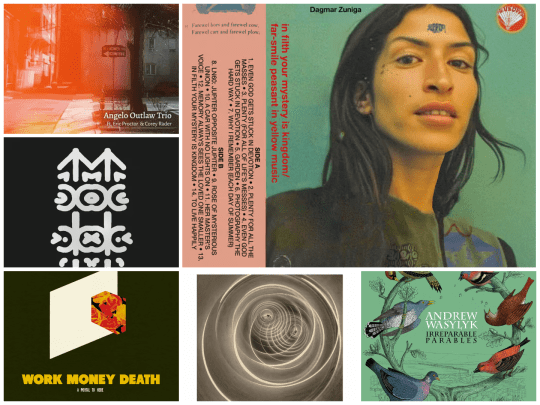
Andrew Wasylyk – Irreparable Parables
With Irreparable Parables, Andrew Wasylyk expands his quietly transportive world by bringing human voices into the frame, and the result feels like one of his warmest, most emotionally direct records yet. Long admired for crafting instrumental music that drifts between pastoral jazz, ambient folk, and cinematic chamber pop, Wasylyk uses this album to deepen that language rather than abandon it. Strings, brass, woodwind, Mellotron, and tape-soft textures move with patience and grace. At the same time, the guest vocalists add a fragile humanity, giving these songs extra weight. Private Symphony #2 with Stuart Murdoch opens tenderly, setting the album’s collaborative tone. As much as we love the vocal element, and we do, Wasylyk has always excelled at instrumentals. First Moonbeams of Adulthood is evidence of that with its smooth instrumentation that blends piano, brass, and woodwind. In saying that, ‘The Cold Collar’ with Gruff Rhys is a standout, pairing Wasylyk’s richly colored arrangement with a vocal performance that feels both intimate and lightly surreal. ‘Love Is A Life That Lasts Forever’, sung by Molly Linen, is even more affecting, glowing with gentle hope as bright brass and tender phrasing turn it into one of the album’s emotional anchors. Rather than simply decorate his sound, these voices make Irreparable Parables feel fuller, braver, and deeply consoling. – WBS
MOb – II
The MOb trio return with their second album, aptly titled ‘II’. The album consists of 7 tracks, with heavy music and heavy messages. The trio of Marios Valinakis (sax, effects, synths), Alexandros Delis (bass, double bass), and Panagiotis Kostopoulos (drums) explores themes similar to those of their 2023 debut, incorporating current situations and societal narratives. The album kicks off with ‘Tipping Point’, which opens with commentary from Waking Monkey on modern issues being diminished and neglected, the spoken lyrics accompanied by synth, heavy drums, and punk-jazz leanings. The track covers social and environmental issues and the lack of awareness among the masses, setting the tone for the album’s commentative nature. The third track, ‘Utu and Sin’, balances synth, saxophone, drums, and bass, serving as an instrumental interlude in the narrative. Waking Monkey returns on “Encounters’, alongside percussion by Angelos Polychronou. The lyrics explore themes of chance meetings and the feeling of shared human experiences. One of the highlights is ‘Fall’, a radical reimagining of the classic composition by jazz legend Wayne Shorter. The album closes with ‘The Listener (feat. Yusef Lateef)’, a 7-minute track that recites Yusef Lateef’s poem ‘The Heart’. The track builds tension as several instruments join in a cacophony, without harmonising, as lyrics are spoken over the music in commentary. The tension snaps when the instruments reflect off each other, establishing a rhythm and relegating an intense, focused overtone for the listener to absorb into a contemplative mood. If you like jazz that draws upon a wide array of influences, this is an album to savour. – AR
Takuro Okada – Konoma
Takuro Okada continues to establish himself as a versatile solo artist, collaborator, and film composer – from his ambient indie‑leaning debut Before (2019), to the cross‑continental collaboration Betsu No Jikan (2022) with Sam Gendel, Nels Cline, and Haruomi Hosono, and his minimalist score for the film After The Fever (2024), which further broadens the scope of his quietly distinctive world. ‘Konoma’, the newest album by Okada, explores identity and a variety of cultures, intertwined with a rare, delicate thoughtfulness second to none. Opting not to emulate the African American music that has shaped him to be the musician that he currently is, Okada approaches the album in a rather unorthodox manner with an “Afro-Mingei” philosophy that mixes together experiences from Black culture with folk traditions from Japan, with harmonising beliefs such as everyday beauty and a passion for one’s craft. With tracks such as Portrait of Yanagi and November Owens Valley, the album unfolds slowly and deliberately, showcasing a variety of genres. From jazz, blues, ambient music, and pulsating rhythms, these tunes come together to form a cohesive whole worth remembering. Konoma is a rich and tranquil space where history and memory unite through sound in a subtle, effortless way. The patience one can feel in each song beckons each listener to slow down and immerse themselves in the sonic wonder. – NG
Angelo Outlaw – Angelo Outlaw Trio
It’s never too late to discover good music; this one came out in October last year, so it’s not that late, but it’s landed with a lovely “where-have-you-been-all-my-life” shine. Angelo Outlaw is a new name to me, and I’ll definitely be checking out his 2024 debut album, Axis Of Time. Backed by Corey Rader and Eric Proctor, the trio, effortlessly blend groove, melody, and atmospheric production. The swaggering opener ‘Agent Orleans’ sets things up nicely. Cool vibraphone lines glide rather than strike, with a rhythm section that delivers a loose, late‑night groove. Our fave, ‘Orbit’, features a circular, hypnotic vibe that shimmers along, doing just enough. The closer, the EP’s most delicate track, features Marrissa Joy, adding a subtle vocal. It’s a fragile, intimate and soft landing. This album is utterly gorgeous from start to finish. I can not stop playing it! – CFS
Work Money Death – A Portal to Here
A Portal to Here extends Work Money Death’s devotion to Spiritual Jazz and the 60s New Thing. It lands with a new emotional gravity after the loss of guitarist Chris Earl Dawkins. The band presents four long pieces: Pain Becomes Prayer And Prayer Becomes A Song, A Dance For The Spirits, Brother Earl, and Sometimes It’s Death. These tracks metabolise grief into a patient ritual. Pain Becomes Prayer… starts in a low and simmering register. Tenor and rhythm section circle a simple figure until it blooms into soaring, Coltrane-indebted ecstasy. A Dance For The Spirits taps into Alice Coltrane’s cosmic sway. Harps and keys float over a trance-like rhythmic bed. Brother Earl is the most explicit tribute. Its guitar-shaped absence appears as wide harmonic space and aching horn lines. The band sounds like it is playing into the outline he left behind. Closer Sometimes It’s Death does not resolve the loss. It sits with it instead and lets drones, cymbal washes, and searching solos trace a fragile path toward acceptance. The record works as both a memorial and a portal. It documents mourning and reaches for transcendence. – IA
Dagmar Zuniga – In Filth Your Mystery Is Kingdom / Far Smile Peasant in Yellow Music
With In Filth Your Mystery Is Kingdom / Far Smile Peasant in Yellow Music, Nicaraguan-American artist and producer Dagmar Zuniga delivers a debut that feels unearthed rather than released, intimate, fragile, and strangely luminous. Built from tape hiss, drifting harmonies, skeletal guitar, and devotional repetition, these 14 tracks move like half-remembered prayers caught on a damaged cassette. The album’s beauty lies in its looseness: songs blur into each other like memory fragments, yet every moment feels tactile and intentional. Among the standout tracks, ‘Even God Gets Stuck In Devotion’ is an immediate centrepiece, balancing haunted folk minimalism with a hypnotic emotional pull that lingers well after it ends. ‘LN60: Jupiter opposite Jupiter’ offers a different kind of spell, more suspended and dreamlike, turning repetition into atmosphere and giving the record one of its most quietly transportive moments. Elsewhere, ‘Why I Remember (Each Day of Summer)’ features ethereal choral harmonies and hypnotic fingerpicked guitar chords. The haunting title track is another highlight, showing that less is more. ‘To Live Happily’, the wordless closing composition features disorienting static, crystalline piano notes, and heavy keyboard drones. Rather than chase clarity, Zuniga leans into mystery and texture, making a debut that feels deeply personal, spiritually restless, and impossible to pin down fully. – WBS
