

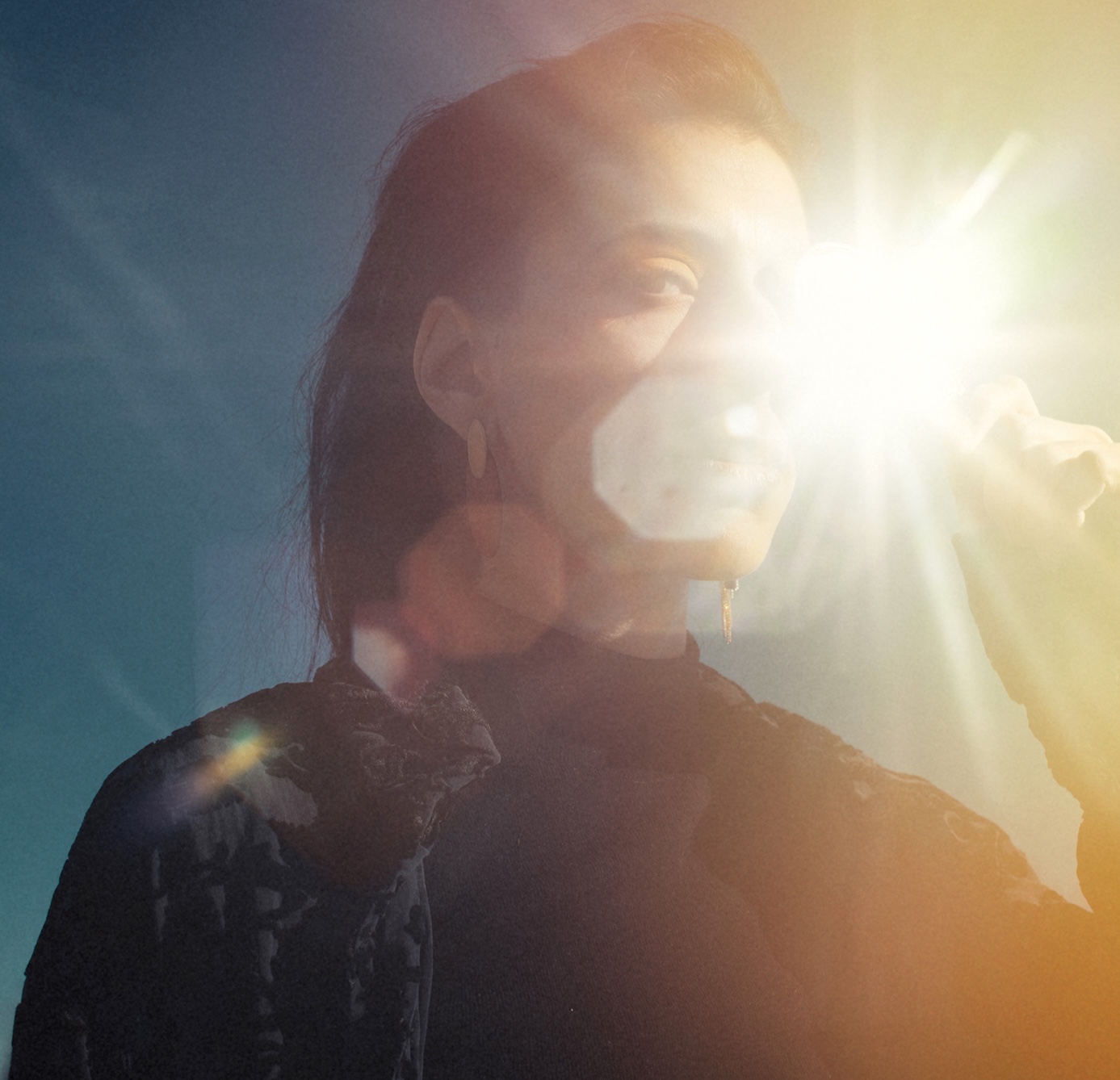
‘The night is darkening around me’ is a beautiful song by Basel-based Argentinian vocalist Luciana Morelli from her upcoming album “Words of the Wind”.
Like the album itself, this track is the result of her interest in exploring different compositional techniques. “Words of the Wind” features Morelli’s favourite poems by Emily Brontë, Alejandra Pizarnik, Anne Carson, and Robin Myers. ‘The night is darkening round me’ is a poem by Emily Brontë. The new record explores themes of family, death, desire, and humanity, and this track expresses a continual feeling of frustration and desperation of being trapped in a place that is getting worse and worse, but nothing can be done. The song reveals a universe of inner turmoil through the diverse timbres and instrumentation.
‘The night is darkening around me’ starts with an eerie brass melody over a dissonant piano vamp. The sustained trumpet and tenor saxophone set up the “mood” of the track and was soon joined by Morelli’s enchanting voice. Her voice and articulation of each word give off an energy different from the original poem, making this track her creation. After a melancholic section, listeners are dragged into the abyss of desperation with slow percussion works and her chromatic accentuation on each note. It is a tapestry of interplay between darkness and light. There are instances where an ephemeral bright ray of light emerges but is soon devoured by a dark cloud of despair. Luciana has done immaculate vocals throughout this track, bringing out these two antithetical concepts.
With the album releasing this Friday, we chatted with Luciana about the forthcoming album, her musical influences, her creative process, and much more.
Hello Luciana! We’re keen to learn more about you. Could you share a little about your background – like where you’re originally from and where you currently reside?
I am a singer and composer, originally from Buenos Aires, Argentina. For 5 years I live in Basel, Switzerland.
I started from my childhood with singing, theatre and dance, and doing musicals. When I was a teenager, I decided to focus on music, and I studied a bachelor’s in jazz singing. But I was always interested in the crossover of the arts and I also studied to become a teacher of combined arts with a specialization in theatre and cinema at the University of Buenos Aires. I was always very active in the independent scene in Buenos Aires, I participated in many projects as a performer and actress, wrote theatre and film reviews in magazines and also organised interdisciplinary art events and jam sessions.
In 2012 I formed my first group as leader and composer “Luciana Morelli quintet”, with whom I recorded my first album “Mandala” (PAI Records, 2014). This experience was very important because it was a gateway to the jazz scene in the city and my first appearance as a composer. Then came other projects, like “Jazz at the movies”, a weekly show where I sang standards that had been part of movie soundtracks. This show was a lot of fun for me, because it partly kept me in touch with the acting, every night I would tell the stories of the movies to the audience, I would make up characters who sang the standards.
But then I felt the need to go back to composing, to keep learning and to develop my own voice and identity as an artist. This brought me to Basel, where I studied two master’s degrees, one in performance and one in composition.
I am still a curious and inquisitive artist and I have made some sound installations, music for theatre and I continue to organise a series of concerts where the crossover of musical genres or arts is valued. I formed a new band with Mauricio Silva Orendain (piano), Philipp Hillebrand (clarinets), Snejana Prodanova (bass) and Paulo Almeida (drums) and released two albums “Lo abismal, el agua” (ears&eyes records, 2021) and this new one “Words of the Wind” (Habitable records, 2024). I also got very involved in the improvised music scene, played with some ensembles and there’s even an album on the way! It’s a field I’ve always been interested in, and I’m happy to be able to explore it.
With the release of your latest album, Words of The Wind, rapidly approaching, could you share your emotions surrounding it? I’m also curious to know what the underlying meaning behind its title is.
This release makes me immensely happy. “Words of the Wind” is my most ambitious work so far, it was a challenge in all directions: as a composer, as a performer and as a producer.
I chose to give it this name because I think it describes a bit the process of creating the album. I worked with poems by women poets from different generations and with a very different style: Emily Brontë, Alejandra Pizarnik, Anne Carson and Robin Myers. And I decided to work with the material with a completely open attitude to what the texts suggested to me. Each poem took me down very different paths, like a leaf being blown by the wind. It was a very playful process of dialogue with the poems, and of listening to my own intuition and imagination without worrying about the result, whether it was going to be recorded or how I was going to carry it out. Of course, it was also a great stress afterwards to coordinate with the more than 20 musicians who participated in the album! That’s why I think I challenge myself as a producer too. But the process of writing and putting together each of the worlds of each poem into a song and then record it all was really fun, and I’m happy to have allowed myself to explore such different compositional approaches and to work with instrumentation that was new to me, such as the string quartet.
The second meaning of the title has to do with the intention to stimulate the listener’s imagination. That, as I did during the creative process, the listener can also let themselves be carried away by these “words of the wind”.
Would you mind detailing the themes or narratives found within the Words of the Wind?
I think that in the album, we find themes such as nature, love, death, loneliness, identity, madness, desire, pain, loss, longing, family, language, memory… These themes are part of the worlds of each poem, some with more direct references and others a little more abstract. In Emily Bronte’s “Fall, leaves, fall” for example, there is the theme of the passage from autumn to winter and the happiness it brings to the character, but on a second reading, this can be a metaphor for the general transformations we go through in life and the small deaths we must accept to make room for the new. In “The night is darkening around me”, on the other hand, she describes a dark force that seduces her and her resistance to being carried away by it. Bronte’s third poem on the album is “Silent is the house”, and here I imagine a love story that for some reason is impossible or far away, there is something that is going to happen and it is inevitable and there is a desire to seize the present before it is too late. But then there is Alejandra Pizarnik, who is much darker and self-referential. Her poem speaks of language itself, of the search for words, although I think there is also something very passionate, of someone who suffers for love in an almost pathological way and uses poetry as an exorcism. On the other hand, the poem “Antelmo to his daughter” by Robin Myers, is for me of a very fragile tenderness, it is a letter from a father to a daughter, it speaks of that very intimate bond and the things that a father has for that daughter’s life in a letter that tastes like a farewell. And lastly, we have Anne Carson, a writer a little older than Myers but also contemporary, and the poem I chose from her is from a series of poems called “The life of town’s” from the book “Plainwater”. There are many references to the senses, to listening and seeing, a reflection on experience and observation. Also, the fragmented way in which it is written, with a full stop after each line, was very appealing to me and inspired me to work with the almost exhaustive musical development of each line, using repetition and fragmentation. Of course, they are all my own interpretations.
What influenced your selection of the tracklist for the album? For instance, is there a specific reason why ‘Fall, leaves, fall’ is the opening track and ‘Todo pasa’ is the concluding one?
When choosing the order of the songs on an album, I always think about designing a good journey for the listener. The intro of “Fall, leaves, fall” seemed to me to be a good start to get people into the album. And the last track was the same for me. I liked the idea of ending with a song about the ephemerality of each moment, and it also has that instrumental coda that leaves an open ending.
You blend an eclectic range of elements into your music, from Argentinian music and jazz to folk and sound poetry. Could you share your approach to this multi-genre style?
Well, this mixture comes naturally to me; it’s part of my identity.
Argentine music always accompanies me whatever I do, even if sometimes I choose to highlight it more, for example, using rhythmic claves or forms of Argentine folk music, and sometimes it appears more washed out or becomes less present, but it’s always there. And jazz is nothing more and nothing less than the language from which I decide to make music, a place from which I make and think about music.
While composing I also listen to a lot of music at the same time and I choose my references of that moment, those songs I’m in dialogue with when creating, from which I “steal” what I like. Sometimes I even make a playlist with the songs that serve as references while I work.
So I could say that, although there are decisions that I make during the composition, this mixture is something that is part of my style, so there is an unconscious part of that, that just manifests itself in my music.
When it comes to the breadth of your sound, could you tell me your top three influences if you had to choose?
This is a very difficult question! I don’t know if I can name only three influences. I’ll try to say the first names that come to my mind: Esperanza Spalding, Camila Meza and Caroline Shaw.
While composing the music for this album, I listened a lot to Caroline Shaw, she was a great inspiration for the pieces for strings and voices, but on the album there is also a lot of Gabriel Fauré, Manuel de Falla, Gil Evans and Andres Pilar, who plays and arranges for the Argentinian folklore orchestra Don Olimpio.
I also should name Guillermo Klein, Björk, Norma Winstone, Meredith Monk, Gretchen Parlato, Becca Stevens, John Cage, Cuchi Leguizamon, Charly Garcia, Spinetta… and so many composer friends I admire like Francesca Gaza, Mariano Sarra, Paz Villahoz… All this eclectic music, present and past, influenced me.
I love album covers, and the artwork for Words of the Wind certainly catches my eye. Could you share some details about the artistic design?
Thank you! I am very happy. The cover photo for the album was taken by the Swiss artist and photographer Andrea Ebener. The hair and make-up was done by my friends Salo and Lucianne who run a hairdressing salon in Zurich, Nanai Salon.

We chose elements to improvise with. Among them were mirrors and flowers. The aim was to achieve some photos in which something of the real looks slightly strange, a poetic wink. When Andrea handed me the final photos, that photo was my favourite without a doubt. I think it captures the essence of the album very well. I am behind some flowers almost like in a Magritte painting, because of the position and the size of the flowers that cover almost the whole face, there is something surreal and poetic in the composition of the photo. Also, the colours, those violet and pink tones and the lilies suggest a very feminine poetic universe.
The graphic design and illustrations that appear on the back cover of the album as well as on the booklet, were in charge of my brother Ignacio Morelli. The aim was to make reference to those old books with illustrations and stamps. Taking the cover photo, he designed a stamp and chose very subtle elements present in the poems to make illustrations that appear in the booklet.
What is the greatest pleasure for you in creating music?
Creating in general fascinates me and seems to me something wonderful, to make something happen, to make something possible, to concretise an idea, something that was in your imagination and to make it come true, it’s something wonderful. I think that’s what gives me the most pleasure: to make what I imagine possible. And, of course, this is made possible in the link with others. So also creating music with others and sharing it gives me a lot of pleasure and gratitude. When someone sings or plays something I wrote I feel very grateful. Above all to be able to take my music to different places and have different people listen to it and see what happens with it. In every interaction the music reinvents itself and no longer belongs to me, it has a life of its own. Also through creation I can get to know myself better, even discover things I didn’t know about myself or didn’t know I was capable of. That’s why I also love improvised music.
You’re about to hit the road with your album. Can you give us a sneak peek into what your performances will entail?
I can’t give too many details yet because the tour is still being put together! But for the moment, I can say that there will be a special performance in Basel, Switzerland, where I will try to invite many of the musicians who have recorded on the album, and some concerts in other cities in Switzerland. In 2025 there is a tour in Germany coming up, and it is my wish to be able to put something together in Buenos Aires. So stay tuned to my networks or website, where I will be announcing the news.
Anything else you would like to add? Any closing words for the Twistedsoul community?
I would just like to thank you for the space, for listening, for asking me these questions that make me reflect on my own praxis and that is very enriching. I hope that readers and listeners will enjoy my music!
